|
News 2005
December 2005:
Thuma Forest Reserve has exploded! The rains have woken up all life and have transformed
Thuma in one big green 'ocean': trees and shrubs have grown fresh foliage, grass 'jumps' out of the soil and flowers, being visited by beautiful coloured
butterflies, are found everywhere.
|

The scouts Bosco (holding a hoe), Gerald (holding a locally made gun) and Polah (holding a bow and arrows) with some of the, in 2005,
confiscated items; the wire just in front of the scouts are the 325 snares we removed.
|
|
December is also the moment of looking back. That 2005 was an exciting and successful year, you can read on this
page.
And 2005 proved that our work is absolutely necessary.
In total we:
- arrested 105 people involved in illegal activities in Thuma,
- destroyed 113 heaps of illegal charcoal,
- removed 325 snares,
- and confiscated 65 pangas (big bush knifes), 25 axes, 36 hoes plus several shovels, iron bars,
sickles, files; 2 guns, ammunition, 2 bows and arrows, a club, fishing nets, poisoned bread, pots, plates, water tanks and many bundles of bamboo, bags of charcoal, planks
plus several other items.
It proves that even a relatively small group of motivated and dedicated people can make a difference. And in 2006 we
will continue our work in preserving Thuma Forest Reserve and its wildlife!
|
November 2005:
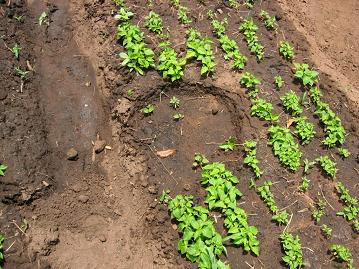
In September this year we have started the project "Growing of Chilli Pepper for Chilli (De)fence" (see September News).
The chilli seeds were sown in the villages at nurseries one and a half month ago and as soon as the first rains will come, the seedlings will be transplanted to the fields of
the farmers.
Although the project runs very well so far, we were faced with an act of 'sabotage' this month: see picture. Apparently an Elephant found it necessary to walk through
one of the nurseries! Fortunately the damage to the nursery and seedlings was minimal. And once the chillies of the full-grown chilli plants are going to be used on the chilli
fences around farm fields next year, the Elephants will expected to start 'thinking' twice before they enter a chilli (de)fenced area! |
|
For those who are interested to know where we are staying or where you will be staying when you join our volunteer
programme, take a look at some pictures of our base
camp.
October 2005:
In this month we were able to put extra focus on law enforcement. The results: we arrested 28 people (mainly bamboo cutters
and charcoal burners) and we confiscated 21 pangas (chopping knifes), 1 axe, 1 iron bar, 1 hoe, 1 shovel, 1 bag of charcoal, 4 water tanks, 1
tin bucket, a pole for construction + 2 bundles of bark rope, poisoned bread, a bow and 2 arrows, and we destroyed 32 heaps of charcoal and trees which were already chopped down for
the purpose of making charcoal.
The poisoned bread was hung up in a tree by poachers to kill Elephants. They probably use rat/mouse poison to poison the bread. As soon as the poachers see that the bread has been
eaten they will follow the track of the Elephant until they find the dead or dying animal. Fortunately
no Elephants had touched the bread: apart from the
fact that it would be a useless loss of
an animal, it would also mean a very slow death with a
lot of suffering, especially for a big animal like an Elephant.
September 2005:
Daan K�ller and Martin Hofman, two volunteers from the Netherlands, joined our team in Thuma this month. They have rebuilt
the kitchen which after years of service was about to collapse and they constructed an excellent basic bush camp site. Another good reason to visit Thuma Forest Reserve!
MEET (Malawi Environmental Endowment Trust) has approved our project proposal "Growing of Chilli Pepper for Chilli (De)fence". The project goal is: "to
promote chilli pepper production as an alternative source of income for the communities living adjacent to Thuma F.R. and as a
sustainable measure to control crop raiding elephants".
In other words: chilli is a commercial interesting
crop which is hardly raided by wild animals and for that reason it
is an excellent crop to grow near the boundary of the forest. Besides that, a part of the chilli crop (the rejects) can be used in the coming years to build and maintain the chilli fences, with which W.A.G. has been experimenting this year (see below), in
order to protect other crops like maize, tomatoes, cassava and so on.
 |
|
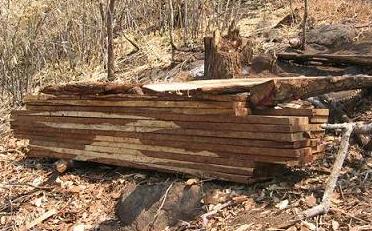
This month we discovered a place in Thuma where illegal plank cutters were active. They had chopped down several
old Wild Teaks (Pterocarpus angolensis). This tree produces a high-quality heartwood and is therefore much wanted for making furniture. Only the thick and straight parts
of the tree are used for sawing planks so besides the fact that it is illegal to cut down trees in forest reserves, it is also a huge waste of material.
In total 29 planks were confiscated, each up to10 feet long and 2 inches thick, representing a value of about half a year average income in Malawi. Bringing all these
planks to our Base Camp was a challenge on its own since every plank weights about 20 kg each! |
And via our sponsor a scout program, W.A.G. has been able to employ a new scout. His name is Bosco Kayenda, 24 years old, very motivated and as our sixth
scout a very useful strengthening of our team!
August 2005:
This month we arrested 11 poachers: 7 charcoal burners on the West side of Thuma where illegal charcoal
burning is still rampant, and 4 fishermen who were using a natural poison to kill and collect fish in one of the streams in Thuma.
The poaching pressure is expected to increase in the coming last months of the dry season, like every year. There are no crops growing in this time of year so the people have time
for other things besides farming. Besides that, Malawi, one of the poorest countries in the world, is hit by famine again this year: the total maize (the staple food of Malawi)
production this year was only about one third of the total annual consumption in Malawi which will boost poaching
activities to generate alternative income.
That is why community projects around forest reserves
(and other reserves) are an important part of conservation in order to assist the villagers in finding legal ways to improve their livelihoods, an aspect W.A.G. is focussing
on now.
In the last months, we have noticed an increase of wildlife sightings in the part of Thuma where our camp is located.
Though the natural wildlife densities (carrying capacity) in habitats like the ones found in Thuma is relatively low, the chance of meeting buffalo, kudu, bushbuck, warthog and
other wildlife is rising. This is a clear result of our intense anti-poaching patrolling in the area: less animals are lost by poaching and more and more
animals seem to seek refuge in this safe
part of Thuma.
Hopefully in the near future W.A.G. will be able to employ enough scouts to make the whole of Thuma a safe wildlife sanctuary.
And you can assist us by sponsoring a scout!
Since Forestry Department doesn't have a representive working near the East boundary of Thuma, W.A.G. has started
selling permits for Forestry Department in Mphinzi village just outside Thuma. A permit costs 10 Malawian Kwacha which is the equivalent of about 7 Euro cent and allows the villager
to collect one head load of firewood (the amount of firewood one person can carry) or 10 bamboos.
July 2005:
On the 21st of this month, Claudia Biese from Germany has started her volunteer work in Thuma. For the next 4 weeks, she will collect geographical
data of the bamboo areas in Thuma with the GPS. Bamboo is an important building material in Malawi and people are allowed to harvest bamboo under a permit or license. However, it is
important to know the extend of the bamboo areas in Thuma to make sustainable harvesting possible and not to deplete the bamboo recourses.
| "Children are the future". It's a clich� but true. That's why W.A.G. has organised our
first 'Conservation Excursion' in Thuma for 20 school children from Mphinzi village, East of Thuma on the 15th of July. Hiking around in Thuma, telling them about the
need for conservation, observing the animals we encountered and showing the children the many signs (prints, droppings, pushed down trees) the animals leave behind in the forest. We and the children had a great day which was closed by presenting all the children with a Wildlife Diploma.
The head master of the school has already asked us whether it's possible to organise more excursions like this for the other 480 children of the school... |

|
On the 10th of this month, in a joint action with Forestry Department and the police, we
confiscated about 150 bags of charcoal in the village Maweni, North of Thuma. The charcoal was produced from trees which were illegally chopped down in Thuma. The action was
initiated by W.A.G. after the scouts had arrested 3 charcoal burners from Maweni in Thuma. Though this must be considered as a victory over poaching, it also proves that the
pressure on forests reserves in Malawi is still big and even increasing, and it strengthens W.A.G.'s aim to raise the number of scouts as soon as we have the means to do
so.
The chilli experiment which Kristina has started 3 months ago in Thuma (see below) has produced promising results: elephants seem to start avoiding chilli (de)fenced areas. This month the
next phase of the experiment has started: implementation on the farmers fields outside of Thuma. The National Smallholder Farmers' Association of Malawi (NASFAM) and Cheetah
(MW) Limited, a chilli trading company in Malawi, have been so generous to assist W.A.G. and the farmers by supplying a large amount of chilli to extend this project that hopefully
will contribute to a better co-existence of man and elephant.
June 2005:
| On the 22nd of June, the German volunteer Kristina
celebrated her birthday in Thuma. She invited friends, the Group Village Headman of the villages at the East side of Thuma, a local band and dance group, each scout and
worker of the Wildlife Action Group brought one or two guests and at noon the party started big time. Soon there was dust all over the place and that's how a Malawian
party is supposed to be! |

|
Traditional medicine, made of parts of trees, shrubs and herbs, is for most Malawians a significant part of the medical
care in their lives. Besides that some of these plants also have an important magical use. Every village has its own herbalists who collect plants and prepare medicine to tread
almost any disease. Forest reserves are an important, and for certain plants very likely the only, source from which these plants come.
The Dutch volunteer Deborah Mets studies traditional (Chinese) medicine in The Netherlands and is spending a month in Thuma Forest Reserve to make an inventory of the plants the
traditional healers use, in how far they depend on the reserve to find and collect these plants and how important these traditional medicines are to the villagers in Mphinzi, a
village at the East side of Thuma.
On the 13th of June, during a 2-day patrol, the scouts arrested 4 charcoal burners in the far West of Thuma where illegal charcoal burning is still a huge problem. The
charcoal burners were handed over to the police in Salima and a week after brought before court. The judge on duty acknowledges the heavy deforestation problem in Malawi and all the
environmental problems that result from it and convicted the charcoal burners by virtue of the Forestry Act 1997 to 1 year and 3 months in prison, each. This is such big (and good!)
news that it was even broadcasted on Malawian radio.
Hopefully this will make it clear to everybody that deforestation is illegal and has to be stopped now: a Malawi without forests will be a Malawi without any chance for a better
future.
On the 9th of this month the scouts and volunteer Kristina found and removed an astonishing number of 98 snares in a part
of Thuma. All snares were new and not used before so it's a huge 'investment' loss for the poacher.
May 2005:
|
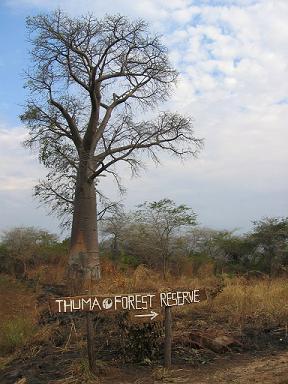
Thuma Forest Reserve is without a doubt a special and beautiful place. The few visitors that have visited Thuma all react very
enthusiastic. Now there is permanent management and staff living and working in Thuma, it's time to start promoting Thuma among eco-tourists and other visitors from Malawi
itself and from abroad, as an excellent place for one or a few days in the bush.
To promote Thuma we made the Visiting Thuma webpage more clearly to potential visitors (entrance fees and directions on
how to get to Thuma), made a pamphlet inviting people to visit Thuma and hung it out in several places along Lake Malawi and in Lilongwe, and we have started putting up signs
along the road, making it more easy for people to drive up to our base camp.
Since the Wildlife Action Group is a non-profit organisation, all revenues from
eco-tourism will of course contribute directly towards the protection and further development of Thuma Forest Reserve.
Welcome!
|
| Thuma Forest Reserve is inhabited by a significant population of elephants (estimate: about 100). Their prints and droppings can
be found everywhere throughout Thuma; and in the evening and night, when they become more active, they are often heard. Though, because of the rugged terrain and thick bush,
it is actually not often that you can have a clear view on them. In the last weeks, however, we had two big elephant bulls staying around camp and in the morning on the 8th of May one of these bulls passed camp very near,
giving us the opportunity to actually make a picture of this magnificent and elusive animal. |
 |
Kristina
R�sel and Heike Trosin have created a German version of our website. You can visit this website on:
www.wildlife-malawi.de. Danke
sch�n!
Now the
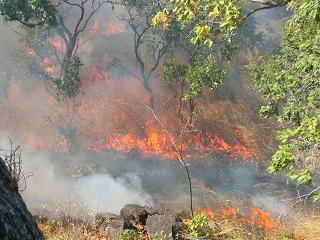
rainy season has ended, the trees start loosing there leaves and the grass is drying, we have started early burning in Thuma Forest Reserve.
Fire is an important factor in the evolution of East and South African eco-systems: it occurs since thousands of years and the organisms living in these eco-systems have adapted to
this often yearly event. In fact: studies in other sub-Saharan countries have shown that the exclusion of fire can lead to diversity degradation in these eco-systems.
Besides this, trying to prevent fires in forest areas will lead to an accumulation of dead trees and other dead material during the 'non-fire' years and will eventually
inevitable lead to that one huge, extremely hot fire that destroys all life: a phenomenon well known, though unfortunately by experience, in the Western world now.
So yearly, controlled early burning, when the fires are short and not extremely hot, is an active forest management tool which should not be ignored.
|
Early burning.
|
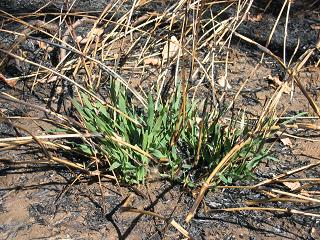
After a fire, the grass
produces new green foliage,
much preferred by animals.
|
April 2005:
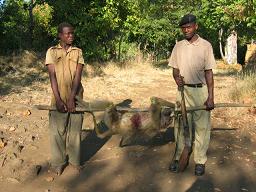 |
On the 18th of April, the scouts managed to confiscate a dead baboon and the gun that was used for killing
it. Unfortunately, the poacher escaped. The gun is a 'locally made gun': it looks of poor quality but is apparently good enough to shoot an animal with.
|
 |
The German volunteer Kristina
R�sel has been so generous to donate a one year salary for a scout (Oliver Polah) so the Wildlife Action Group has been able to raise the number of scouts from 4 to 5. Our ultimate
objective is to employ 12 scouts in order to improve the protection of the whole reserve, including the most remote areas.
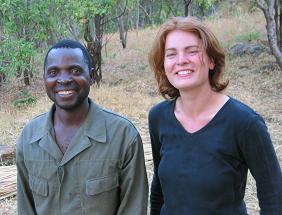
Oliver and Kristina
Human - elephant conflicts are a
major problem in large parts of Africa. Especially in areas where villages and farm lands border National Parks and Forest Reserves, crop raiding by elephants can be a significant
problem. Since more and more elephants seek refuge in Thuma Forest Reserve, crop raiding also has become a problem around Thuma. Although our experience is that the actual damage
caused by the elephants is often exaggerated, it is a message from the villagers which should not be ignored. Unfortunately, the most used 'solution' by government to solve
these conflicts is to shoot an elephant, often only wounding the elephant, which on its turn can become a very aggressive and dangerous animal towards people, creating an even more
undesirable situation. That is why the W.A.G. is looking at other ways to approach these human - elephant conflicts.
One way in which elephants can be discouraged to raid crops is the use of chilli pepper. Some good results have been achieved in other African countries, though the method and way
of using the chilli has to be adjusted to the local situation.
Chilli is a highly irritating natural substance (our own experience!), especially to animals with such an excellent smell as elephants. There are several ways in which the chilli
can be used. Kristina R�sel has
started experimenting with the chilli by putting up two bamboo fenced feeding places with bananas in Thuma. On one of the bamboo fences, little baskets with chilli powder are hung.
To reach the bananas, the elephants will have to break through the fence, releasing a cloud of chilli powder from the baskets which will hopefully convince the elephants never to
look for the bananas on that feeding place again!
If elephants will actually start to distinguish between the 'irritating protected' feeding place and 'unprotected' feeding place, it might be a cheap, easy and
non-harmful way to assist the farmers in protecting there crops in the future and at the same time protect the elephants from being shot.
Three vervet
monkeys who where confiscated (people sometimes illegally sell them along the road), brought to, hand raised and finally released in Thuma Forest Reserve by the Wildlife Action
Group two years ago, have turned up in our camp in Thuma again! Paying us a regular visit now, together with the group of wild vervet monkeys they've joined, they give us a lot
of fun but also some 'headache' because they are experts in steeling our fruit and other food items we leave unattended!
Now the rainy season has ended and the tall elephant grass (up to 3 meters) is getting dry, we have started to (re)build new grass huts, shower, storage huts and so on for the
volunteers and visitors who will visit Thuma this year.
March 2005:
|
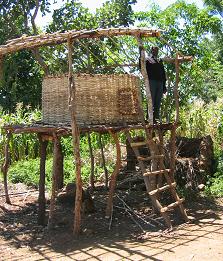
Enclosure on poles to protect goats
from hyenas during the night.
|
The
Belgian student Jurgen De Braekeleer from the Bachelor School for Nature and Wildlife Conservation in Gent has made a first inventory on the damage to crops (mainly maize,
groundnuts, potatoes, cassava and bananas) and to livestock (mainly goats) caused by wildlife and the way villagers try to protect their crops and livestock. The interview
took place in the village Mphinzi, just outside Thuma. According to the villagers most damage is caused by respectively elephant, bushpig, baboon and hyena. Though
elephants not often
enter village areas, when
they do, they (can) cause serious damage to crops because of their size (and so huge appetite!) and because the villagers have no effective means to chase
them
away.
We have added lists with the recorded wildlife of Thuma Forest Reserve to our website.
|
February 2005:
The Wildlife Action Group will, with 6 months financial support of the European Union, start a project to pilot and
demonstrate how sustainable charcoal production outside Thuma Forest Reserve can be achieved. As a part of this sustainability the Wildlife Action Group tries to stimulate the
surrounding communities to plant trees around their villages. This trees (Scientific name Acacia polyacantha, local name mthethe) will be used in future for the
charcoal production instead of illegally cut down trees of Thuma; in the last months over a thousand trees have been planted already. In the coming months two kilns will be build,
one on the East-side of Thuma and one on the West-side, which will be used for legal charcoal production. These kilns have a high efficiency in turning wood into charcoal: up to
three times higher than the illegal way of charcoal production in the forests. In addition the project will show how the degraded bamboo areas within Thuma's boundaries can be
improved for the benefit of the communities around this reserve.
For the next 9 months, Albert Schenk, from the Netherlands, has been appointed by the Wildlife Action Group as Project Manager in Thuma which will make it possible to intensify our
research and anti-poaching patrolling in Thuma and re-activate our volunteer program. Volunteers are most welcome!
Student Jess J�rgensen from the Danish Royal Veterinary and Agricultural University (KVL) will start a research (2 months) on the importance of (illegal) bush meat and charcoal from Thuma to the local
communities.

Tree illegally cut down for making charcoal.
|