|
News 2006
December 2006:
The year 2006 has ended and looking back, like in
December 2005, we can say it was a successful year! And more important: we did even better than last year. And that's our 'personal' goal: a continuous improvement of our
conservation efforts in Thuma F.R. for the benefit of Malawi.
Some highlights:
 |
- We have made local people living around Thuma F.R. beneficiaries of conservation via the several community projects we
have conducted this year in the communities;
- we have made the legal collection of bamboo in Thuma F.R. by communities around Thuma F.R. possible again;
- 14 volunteers and students have assisted us this year in Thuma F.R.;
- we have enjoyed an increase of visitors visiting Thuma F.R.;
- the membership organization W.A.G. Support in Europe has been founded this year;
- thanks to funding from individuals and donors, we have been able to double the number of scouts employed by W.A.G. to 12,
resulting in a 100% law enforcement coverage of Thuma F.R.;
- in total we have arrested 207 poachers in Thuma F.R. (mainly illegal charcoal burners and bamboo cutters) and confiscated
45 bags of charcoal, fire wood, 39 axes, 33 hoes, 69 bundles of bamboo, 118 pangas, 135 planks, six 7-feet saws, 3 bow saws, 1 gun plus bullets, 2 bows and arrows, 1 club, bush
meat, fishing nets/poison/ traps and lines, illegally caught fish, plus many other items used by poachers like pots, plates, buckets, sickles, files, knifes, water tanks, a torch
and others. Besides this we destroyed 97 illegal heaps of charcoal found in the forest, 2 pit traps and we removed 434 snares.
Most of this law enforcement success is the result of the strengthening of our field team and the consequential expansion of the area where we are now able to patrol regularly
(for example: in December this year the scouts spent a total of 240 man-days in the bush!);
- and plenty of wildlife has been observed in Thuma F.R. by visitors and field staff this year!
|
November 2006:
The Mammal Survey 2006 which we started in June this
year, is rounded off. A lot of data on the mammals in Thuma F.R. has been collected in the last months and
some very interesting conclusions can be drawn from this data. If you are interested in our findings, feel free to download the
Mammal Survey 2006 Report.
The elephant dung count we had planned for the second half of 2006, has not been conducted yet. Reason for this is the
observation that elephant dung hardly decays (disappears) in the dry months but simply dries out completely and remains unchanged until the first rains come. Since the decay rate is vital
factor in a dung count survey, further research on the number of elephants living in Thuma F.R. has to wait until the first half of next year.
Finding proper boots (shoes), which can endure the many kilometers of patrolling done by the scouts through the rugged
terrain of Thuma, is (almost) impossible in Malawi. At the moment, our scouts have only one pair of boots which is very inconvenient in the rainy season since wet boots take a few days to
dry. If you have any spare (army) boots which you would like to donate to W.A.G., you're most welcome!
October 2006:
W.A.G. has employed 3 new scouts (recruits): Mark
Kambwiri, Edison Banda and Simeon Viktor. Next month another 3 recruits will be employed, bringing the total number of scouts at 12.
The Task Force, mentioned in September news, has not been re-activated (yet?). Lack of (financial) resources of
the Department of National Parks and Wildlife (DNPW) and of the Department of Forestry is probably the main reason for
this.
However, fortunately, the grant from the United States
Fish & Wildlife Service provides W.A.G. with a budget for paying day allowances for an armed DNPW game ranger who, with the start of this month, is based in Thuma F.R. and who will join
our scouts during their patrols in the coming 12 months.
This makes the so much required, immediate response to the poaching incident of last month possible and effective.
Although we cover many kilometers in the field daily for years now, there are still new things
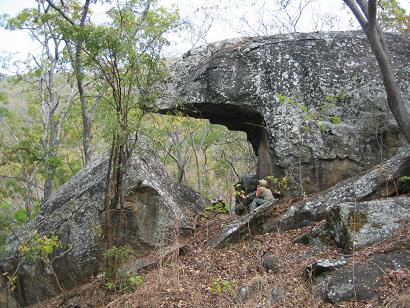
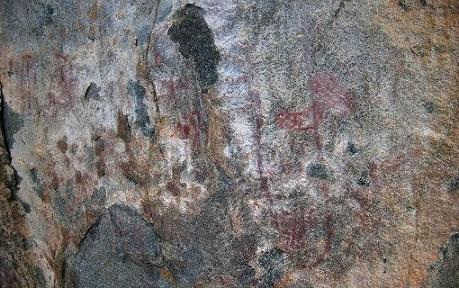
to be discovered in Thuma F.R.. This month we discovered a cave with rock paintings (see pictures below). The game ranger, who was patrolling with us that day, told that he has seen other
rock paintings in other parts of Malawi (Dedza, Mulanje) and that they are similar to the ones we found in Thuma F.R..
A fascinating discovery, untouched since, possibly, prehistoric times!
Note: The distance to the Rock Paintings Cave is only about 2 hours
walking from our camp so that is an extra reason to pay Thuma F.R. a (day) visit!
Vikt�ria N�meth, a student from Hungary, has spent 4 weeks in and around Thuma F.R. assisting Matias Elisa with W.A.G.'s Conservation awareness Project.
September 2006:
On the 22nd of this month, after following the tracks of poachers for 3 days in a row from inside Thuma into the adjacent
Dedza-Salima Forest Reserve, we discovered the fresh carcass of a young elephant bull in Dedza-Salima Forest Reserve. The young bull was shot by the poachers and decapitated, the body left
behind to rot away. A clear indication that these professional poachers were only after its ivory. Although a young bull carries only small tusks, it is obviously still rewarding for poachers to hunt elephants this size. Even if the amount of money they receive for
these small tusks is only small in our(!) eyes, for the poachers it is apparently still an interesting (extra) income.
The incident was of course reported directly to the director of the Department of National Parks and Wildlife and to the director of the Department of Forestry. The directors have
immediately decided to revive the so called Task Force: a joint, armed, rapid action force of the Department of National Parks and Wildlife and the Department of Forestry, established in
recent years but never really activated due to lack of financial resources. Its primary goal is to assist the Department of Forestry in case of serious incidents (like the one described
above) occurring in or around forest reserves. A most welcome initiative which will hopefully not strand in bureaucracy: if the Task Force can assist W.A.G. with patrolling the area in the
following weeks, it will send a clear message to all poachers that there is zero tolerance towards (gun) poaching.
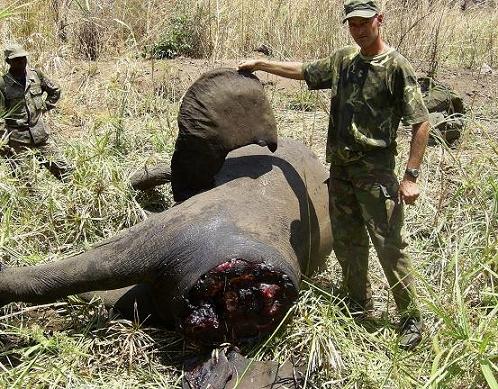 |
| The shot young elephant bull, found in Dedza-Salima Forest
Reserve. |
.
But there is also excellent news this month:
Kiboko Camp & Safaris (www.kiboko-safaris.com), a leading safari tour operator based in Malawi and operating in both Malawi and Zambia has been so generous to assist W.A.G. by
sponsoring a scout.
And the United States Fish & Wildlife Service (www.fws.gov) has granted W.A.G. significant funding
from their African Elephant Conservation Fund for a period of one year to support our "local anti-poaching efforts in and around Thuma Forest Reserve".
This is huge step forward: making it possible to raise the total number of scouts employed by W.A.G. to
12!
All this support W.A.G. receives from organizations, companies and individuals hopefully reflects the
trust people have in our conservation work in Thuma and the difference we try to make. Many, many thanks!
And Charlotte Lay and Stephanie Walker, two students studying Wildlife Conservation at the University of
Plymouth (UK), have come to Thuma to do their placement.
August 2006:
This month we made a start with collecting data for the elephant dung count (to
estimate elephant numbers in Thuma) we are hoping to conduct in the coming months. Heidi Mansell, a graduate in Biodiversity and Conservation from the UK, has joined our team as a
volunteer this month. In the coming weeks she will try to collect elephant defecation data (:how many droppings does an elephant produces every day); important information which is
required to be able to do a dung count survey but also the most difficult factor to get proper figures on. Best chance you have to collect this data is to find that one big solitary bull
which you are able follow for whole day (without being noticed!).
But so far the elephants are quite cooperative in a way that in the last weeks many elephants have moved
from the more remote parts of Thuma and the adjacent Dedza-Salima Forest Reserve to the part of Thuma where our base camp is located and we have seen the elephants many times in the last
few weeks.
The coming months are the best game viewing month anyhow and everybody who is prepared to do some serious
hiking has a reasonable chance to meet elephants in Thuma (with Buffalo as a potential bonus, as visitors experienced this month).
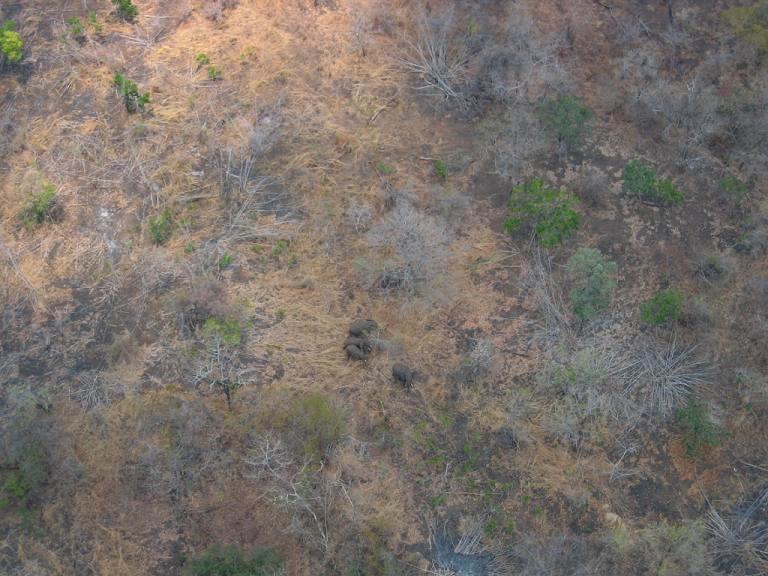 |
|
Thuma elephants: note the many juveniles in the herd.
|
July 2006:
It is amazing what difference the 2 extra, sponsored,
scouts make (see May news)!
With the 7 scouts W.A.G. is able to employ now, we can now patrol in those parts of Thuma F.R. where we were hardly able to go before because of lack of manpower. Regular 2-, 3-
and even 4-day patrols are possible now and that has resulted this month in another significant step towards the full protection of Thuma F.R..
Several poachers, especially from the far West side of Thuma, must have been completely surprised when they discovered that all their snares or illegally cut planks were suddenly
removed or destroyed from those areas where, in the past, they could do there 'work' unnoticed.
Besides this expansion of manpower, the wildlife survey conducted by the volunteers and scouts, also results in interesting discoveries. For the wildlife survey, every square
kilometer of Thuma is being surveyed during these months, following a straight diagonal line through each square kilometer block. This often means tough walking up or down steep
slopes and through thick bush which brings you to places where you would otherwise not go.
Altogether this has resulted this months in: 18 arrests plus the confiscation of 2 fishing nets, 4 axes, 2 hoes, 4 pangas, 1 sickle, water tanks, pots and plates (from poachers
who spend several days in a row in the bush), 2 bags of charcoal, 18 bundles of bamboo, bullets(!), 87 hard wood planks, one 7-feet saw and 180 snares!
Although we are very satisfied with this month's result, we of course hope that this was a unique event and that poachers will become completely discouraged and start avoiding
Thuma F.R., including the most remote parts.
|
|
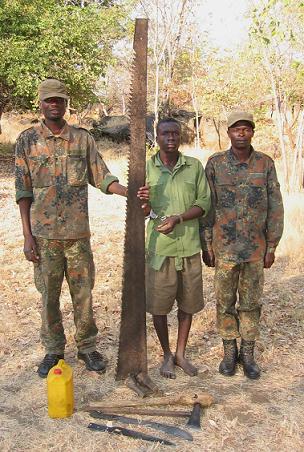 |
|
To the right: The scouts Matthews and Adams with the arrested plank sawyer.
|
June 2006:
W.A.G. - Malawi has a new partner: W.A.G. Support in Europe. This newly established organization is our counterpart in Europe. It is
a membership organization with as its main objective to support our conservation efforts in Malawi. Join us on W.A.G. Support Europe!
The Dutch volunteers Jan-Willem van Hasselt and Lonneke van Zutphen and
the Swiss volunteer Silvia Tschuemperlin have joined us in Thuma Forest Reserve this month. In the coming months they will assist
W.A.G. with the Mammal Survey we are conducting this year. The mammal survey will give us a better picture of which species are living where in Thuma. For this, each square kilometer
block of Thuma will be visited and the signs of all mammal species (sightings, droppings, prints and so on) will be recorded. The data will be used to produce distribution maps for each
mammal species. These collection of maps will give (additional) information on habitat preferences of, plus the effects of poaching pressure and our patrol efforts on, the different mammal
species in Thuma.
And Deborah Mets who already volunteered in Thuma last year has returned to continue her inventory of trees in Thuma and their
use in traditional medicine, a knowledge that is unfortunately slowly by slowly disappearing.
These early months of the dry season is also the time that a lot snares are put out by poachers in Thuma (and
other reserves). For drinking, the animals are becoming more and more dependent on streams, and in the parts where the bush is still thick, it is not difficult to see which
paths are frequently used by the animals to reach the streams, making it easy for poachers to locate good spots to put out their snares.
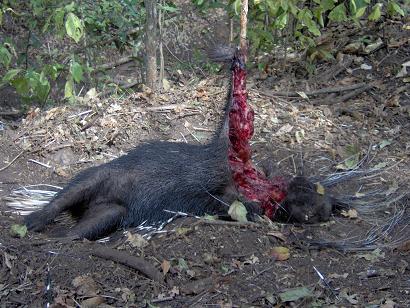
We have therefore put extra effort in finding these snares, resulting in the removal of 121 snares in the last two months. Although still a significant number, it is a major
drop compared to last year around this time (a decrease of over 50%!), clearly showing that Thuma F.R. is getting less and less interesting for poachers because of our
conservation efforts.
To the right: A very unpleasant sight; a Porcupine caught in a snare with its right front leg, partly eaten by other
animals.
|
|
 |
May 2006:
The German organization Rettet die Elefanten Afrikas e.V. (www.reaev.de), which focuses on elephant conservation in Africa, has donated Euro 1,000.00 to W.A.G. via our sponsor a scout
programme, which enables W.A.G. to employ 2 new scouts!
Stella Faur� who started her internship in Thuma last February, has finished her work in Thuma this month and the
result of her literature study is a first recommendation towards W.A.G. on how to 'count' elephants in Thuma F.R.. Because direct counts of elephants in a rugged area like Thuma is
close to impossible, the best way to get an idea of elephant numbers is the dung count method, a commonly used method to count elephants in the thick jungle of Asia, Central and West
Africa.
How does it work? Briefly: if you count the number of dung found along transects in a certain area and you know how many dung piles an elephant produces every day plus how long it takes
before these dung piles disappear again (decompose), you are able to calculate the number of animals in the area.
The basic principle of the dung count method is actually very simple though the mathematics and statistics behind it is, to say the least, baffling.
In the coming months W.A.G. will use Stella's literature study to get a further and full understanding of the proper way a dung count has to be conducted. And we are planning to do a
dung count in Thuma in the second half of this year which should result in the first proper estimate of the number of elephants in Thuma (and maybe even the first in any conservation area
in Malawi in the last years).
April 2006:
We have added a picture page to our website. Click here and enjoy!
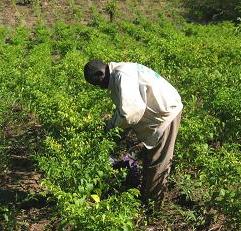 |
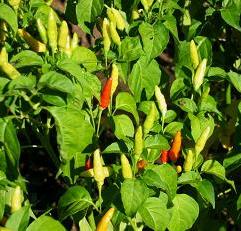
An update on our "Growing of Chilli Pepper for Chilli (De)fence" project (see also the news 2005 page): this month the farmers participating in the chilli project have
started harvesting the first chilli's (left). Most of them can expect a good harvest this first year (the chilli plant produces fruits 3 years in a row) and any rejects will
be used to build the chilli (de)fences. The fact that chilli is not raided by wild animals (like baboons, elephants and bushpigs: it's too spicy!), doesn't require any
fertilizer nor pesticides plus the fact that the (fluctuating) world market price for chilli is high this year, will hopefully stimulate more and more farmers in the area around
Thuma F.R. (and other reserves) to start growing chilli as an alternative income generating activity: this will be of benefit to both farmers and wildlife!
|
 |
March 2006:
 |
After establishing 4 Wildlife and Environmental Clubs in the villages Chembe, Mphinzi, Mvululu and Chimutu (East of Thuma
F.R.) in February, March was the month to organize the first activities for the 4 clubs as part of our conservation
awareness/education project (see the news of January). In the villages Mphinzi and Mvululu, a State Of the Environment Report (SOER) was conducted. Together with the wildlife
club of each village, a inventory was made of the environmental problems in their area. Examples of the (linked) environmental problems mentioned in the SOER are soil erosion,
deforestation, scarcity of clean water and lack of traditional (herbal) medicine. By discussing these problems and their effects on the area and the population, the people
become (more) aware of the causes of these problems and therefore the possible solutions. Besides that, the SOERs can also be used by the wildlife clubs to backup any
proposal they want to submit to the local government and donors in order to tackle these environmental problems.
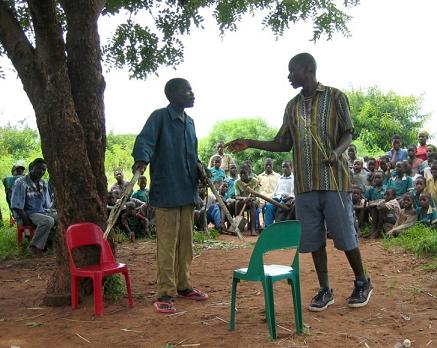
And we also organized the first conservation drama. The Mvululu wildlife club performed their very entertaining play in front of a large
audience on the 31st of the month; see the picture on the left: two 'poachers' are discussing their plans to poach in the forest.
|
February 2006:
This month 2 students have arrived in Thuma F.R. to do their internship: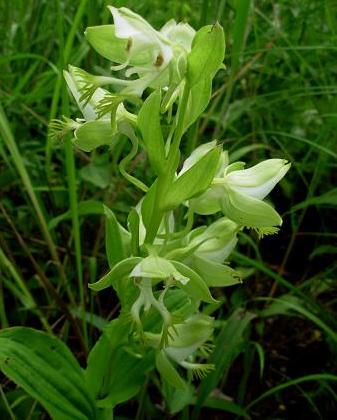
Jan Verachtert from
Belgium is studying Wildlife Management in Gent and will stay in Thuma for 3 months. Jan will make an inventory of the orchid species growing in Thuma and study their ecology. "For a
small country, Malawi is rich in orchids; with over 400 species, it has almost the largest number of any African country." This rich abundance of species might be explained by the
fact that in Malawi "Considerable diversity of habitat is available, from the high plateaus of Nyika and Mulanje, where much of the land lies around or above 2000 m in altitude, to
the hot, low-lying Shire valley only about 60 m above sea level, with numerous intermediates between these extremes." These are quotes from the excellent book Orchids of
Malawi by La Croix et al (ISBN 90 6191 808 1). However, looking at the orchid distribution maps in this book, apparently hardly any inventory work is done yet in the region where
Thuma is located. Jan's work can therefore be considered as real pioneers work and will for certain produce valuable new data. In the next Monthly Newsletter we hope to publish some
of the first orchid data collected by Jan in Thuma (on the picture to the right: the orchid Habenaria splendens).
Stella Faur� is studying Animal Health Care in the Delft, The Netherlands.
During her 3 months stay in Thuma she will do a literature and practical study of the methods available to count elephants.
From a management point of view W.A.G. is very interested in the number of elephants in Thuma F.R.. That the number is increasing is certain but an accurate estimate of the number of
elephants that seek refuge in Thuma is unknown.
That counting elephants is much more complex than it sounds at first hand, might come to you as a little surprise but especially in rugged, forested areas like Thuma, the biggest land
animal on earth can sometimes easily "disappear" in front of your eyes, even when the distance between you and the elephant is not more than 15-20 meter. This makes counting
elephants not an easy job.
The methods available for counting elephants vary from direct counts from airplanes to indirect methods by counting elephant dung (droppings) along transects (imaginary lines through an
area along which you do the counts) by which you can calculate the likely numbers of elephants.
By selecting a good and practical method to count elephants in Thuma plus defining a clear protocol on how to conduct the method, W.A.G. will be able to start collecting useful elephant
data in the years to come.
January 2006:
The Danish Hunters Association (DHA) has approved our 3 micro projects proposals for 2006 which we
submitted to them last month.
DHA has gained a lot of experience in sustainable use and conservation of protected areas in Denmark and is now implementing their experience in Malawi (and other countries worldwide).
The projects they approved are: two beekeeping projects; one in
villages North-West and one in the villages East of Thuma F.R..
Beekeeping is introduced in these villages as an IGA/ALS. IGA stands for Income Generating Activity and ALS for Alternative Livelihood Strategy.
This is 'proposal language' for: assisting the people who are living around a reserve in making a living without them misusing and destroying the reserve.
Within these projects W.A.G. also wants to explore the possibility and effectiveness of using strategically placed beehives along
streams as a possible help to deter crop raiding elephants from the banana crops located along these streams.
Staff from the Department of Forestry and Athan Columbus, a Peace Corps volunteer and enthusiastic and skilled entomologist, will assist W.A.G. with these projects.
The third project is the start of a conservation awareness/education
programme in the villages East of Thuma. Together with Matias Elisa, the experienced conservation extension worker from The Department of National Parks and Wildlife who is already
involved in W.A.G.'s Chili (De)Fence project, we will focus on creating environmental and conservation awareness within the communities by: explaining the need and benefits of protected
areas and its wildlife, establishing wildlife clubs in each village and organizing various conservation activities like excursions to Thuma, conservation quizzes, a conservation drama
competition and a drawing competition for the youth.
|