|
News 2008
November - December 2008:
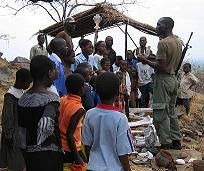
In November the Sunday school from
Salima, 25 children plus teachers, visited Thuma F.R. to enjoy the bush and to learn more about conservation.
On the picture to the right you see game ranger Namani, well experienced in conservation education, explaining to the kids the origin of the different bones in our Thuma
'museum'.
In December W.A.G. sponsored the two wildlife clubs of Mphinzi village and Mvululu village (East of Thuma
F.R.) to organize a tree planting day in their communities. During this day every house(hold) was given a tree by the club members to plant close to the house and of course the
benefits of (planting) trees was discussed within the communities.
|
 |
October 2008:
|
 Most staff member spend an approximately 25 uninterrupted days/month in our base camp in Thuma F.R. and it is this continuous presence inside the reserve that
contributes significantly to the successful
protection of Thuma F.R. and its wildlife:
our view is that you can't protect wildlife effectively from behind a desk in the capital city. Most staff member spend an approximately 25 uninterrupted days/month in our base camp in Thuma F.R. and it is this continuous presence inside the reserve that
contributes significantly to the successful
protection of Thuma F.R. and its wildlife:
our view is that you can't protect wildlife effectively from behind a desk in the capital city.
We are therefore proud and happy to announce that the United States Fish and Wildlife service has approved our additional proposal
in which W.A.G. has requested funding for the "Construction of improved accommodation and workspace structures for the Wildlife Action Group in Thuma Forest Reserve". This means that in the coming
months we can start the replacement of our old "grasshut" accommodation and workspace structures by healthier, safer and more durable structures. The structures will
be constructed by using local, largely traditional, construction methods which will have a minimum impact on the environment and which will make the structures fully blend in with the natural surroundings.
|
August - September 2008:
|
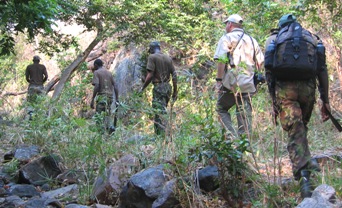
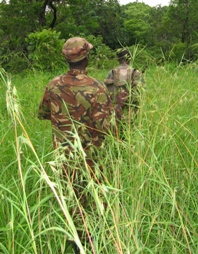
Thomas Toepfer and scouts on a hike
in Dedza-Salima Forest Reserve.
|
In September Thomas Toepfer from the German organization Rettet die Elefanten Afrikas e.V. (R.E.A.; i.e. "Save the African
Elephant", www.reaev.de) visited Thuma Forest Reserve and Dedza-Salima Forest Reserve.
R.E.A. is funding W.A.G.'s "Dedza-Salima Forest
Reserve Eco-system Rehabilitation Project".
The main goal of this
project, which started in October 2007, is to increase the size of the area in this part of Malawi where elephants and other wildlife experience real protection (i.e. not only
protection 'on paper'). The need for this project has become clear in the last years since, due to the protection elephants experience in Thuma F.R., the numbers of
elephants in the reserve have increased significantly; both by reproduction as by immigration from the surrounding 'unprotected' reserves. Thuma F.R. has now the second
highest density of elephants in Malawi (only after Liwonde N.P.) and in order to avoid too much (future) pressure by elephants on the habitats in Thuma F.R. the need to expand the
total area of protection in this part of Malawi is obvious. And fortunately: R.E.A. is more than willing to assist W.A.G. with this.
|
|
Also the United States Fish and Wildlife Service (www.fws.gov) who has been funding our
conservation work in Thuma F.R. in the last 24 months through their African Elephant Conservation Fund, has decided to continue to fund W.A.G.'s operations for another year. In
one word: fantastic!
For those who understand German, an interesting interview with Kristina Raesel, former volunteer and current
chairlady of W.A.G.
Support can be read on the website of journalist Ilona Hupe.
|
 |
June - July 2008:
 |
 |
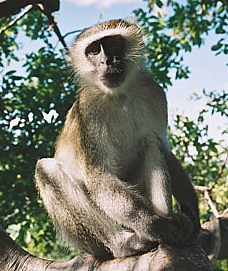 |
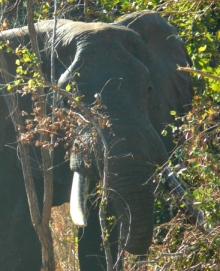
With the bush getting more and more open now, June to December are the best hiking and game viewing
months.
For more information about visiting Thuma F.R. please follow the link: Visiting Thuma.
WELCOME! |
May 2008:
|
This month we have made a start with the third consecutive annual mammal survey in Thuma F.R. (see also January news for
last year's Mammal Survey Report). During the survey, teams of volunteers and scouts survey each of the 205 square kilometer blocks, recording all signs (i.e. sightings,
droppings, prints, burrows etc.) which indicate the presence of the specific mammal species in those blocks.
|
|
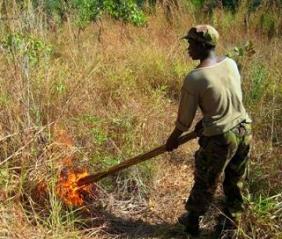
Early burning.
|
For the months August-November we are still looking for volunteers who like to participate in the mammal survey and other activities: for more information please go to: Volunteer programme. Welcome!
May is also the first month after the rainy season that the first drying parts of Thuma and Dedza-Salima Forest Reserve
will be burned through 'early burning'. Early burning is an important management tool with which to avoid the otherwise inevitable occurrence of extremely hot and
destructive fires at the end of the dry season. When implemented correctly, early burning contributes significantly to the preservation of wildlife areas (see also May News 2005).
|
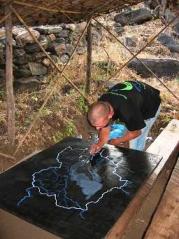
Volunteer Roger painting a
map of Thuma F.R..
|
March - April 2008:
|
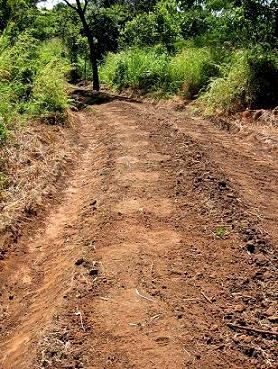
March and April are key months when it comes to road maintenance inside the reserve: the heavy eroding rains
have come to an end but the soil is still relatively wet and therefore soft enough to be tilled (when completely dry the soil becomes as hard as concrete). The Wildlife Action Group
Support (our European branch: www.wildlife-malawi.com), provided W.A.G. with the funding to maintain and upgrade approximately
2 kilometers of road inside Thuma F.R.. Villagers from the communities East of Thuma F.R. provided the required labour and by that earned a welcome (extra) income during these last
2 months before harvesting time when their food supplies from the previous year are running towards their end.
Interestingly, these upgraded roads seem to have an attractive power on elephants. It is well
known that elephants like to use specific tracks to travel from A to B within their home range. These tracks, which provide the easiest way to move around, are often in use for
generations and are part of the collective knowledge of elephants in the area. The elephant, being of an inquisitive nature and always open minded for new opportunities, apparently
has no problem including (new) manmade roads into their elephant road infrastructure. They often use our roads when zigzagging from one side of the road to the other while foraging,
including the 'new' roads, notwithstanding the fresh smell of human labour (sweat!). And we, well, we are of course happy to share, despite the occasional tree that they
like to push across the road.
Picture to the left: Elephant foot prints on the recently upgraded road.
|
February 2008:
The Dutch company &Samhoud has donated funds to W.A.G. to build a heritage centre in Thuma F.R.. Volunteer Alice Mostert,
who works for &Samhoud, has been collecting data about the history of Thuma F.R. and the communities that were once located in Thuma before it was gazetted a forest reserve (in
1926).
In the heritage centre the story of the history of the reserve will be told and information will be displayed about the animal and plant species in Thuma F.R. and the overall
importance of the conservation of areas like Thuma F.R.. The primary target group will be school children from the surrounding communities who will be invited to visit the reserve
and enjoy the bush.
The construction of the heritage centre will start after the end of the rainy season this year.
|
|

|
|